Beginners of Ultimate Frisbee generally find it difficult to pick up the requirements of three of the most common offensive tactics: Ho Stack, Zone Offence and Vert Stack. This piece attempts to make these three key offensive tactics more recognisable and understandable for Ultimate novices with a knowledge of football, by comparing them to three of the most famous football offensive tactics.
In focus will be: the attacking tactics of Jurgen Klopp’s dynamic Liverpool side which will be used to explain the basic workings of a Horizontal Stack offence in Ultimate; the ‘Tiki Taka’ offensive play of Pep Guardiola’s dominant and revolutionary Barcelona side to have a look at Zone Offence and finally how corner kick routines for various football teams can help explain the Vertical Stack.
Ho Stack = Klopp’s Attacking Threat
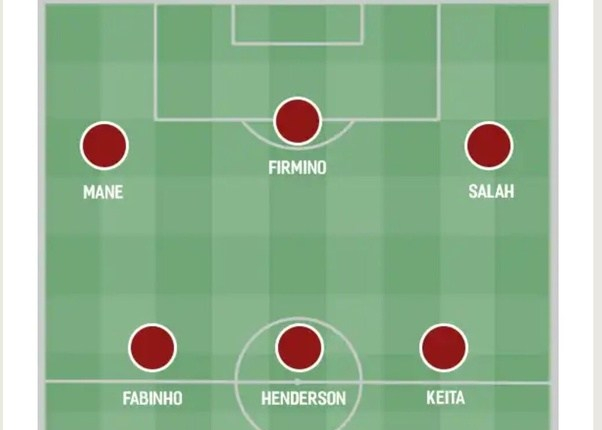
Lets keep it simple. In Liverpool’s team, Sadio Mane on the left, Salah on the right, Keita/Fabinho from behind and Firmino through the middle all work in tandem to create space for Liverpool going forward. If Firmino drops deep there is space for Salah and Mane to cut inside, if Salah and Mane go wide there is space for Firmino to link up with Keita/Fabinho through the middle, if Salah goes deep Firmino comes short etc. A horizontal stack (or ‘ho stack’) works roughly the same way. It typically has 3 handlers playing behind 4 cutters. (See my post explaining Handlers and Cutters in Frisbee for Footballers: Positions)
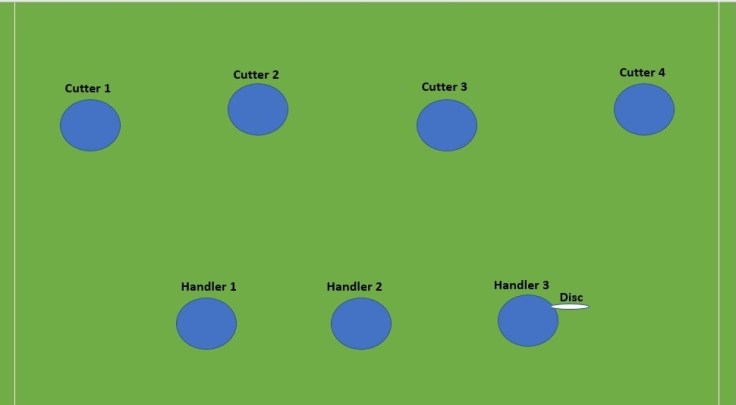
In this formation, the cutters will usually work in pairs – 1 with 2 and 3 with 4 – to run in a diamond shape, moving simultaneously (one towards and one away from the handler with the disc) to create options for the player with the disc. In the above example Cutter 4 will cut towards Handler 3 and Cutter 3 will go deep away from the handler. Just like Liverpool’s forwards when their midfield 3 have the ball, cutters in a ho stack will alternate their runs deep and short, to create multiple options for the handler with the disc to play a pass.
Handler 2 also has an important role here too, just as a player like Keita does for Liverpool. If cutters 3 and 4 have been marked too effectively then Handler 2 needs to help out Handler 3 by offering a ‘dump’ option, i.e. a backwards pass, or by making a forward cut themselves into the right wing position. (See red arrow in graphic below) 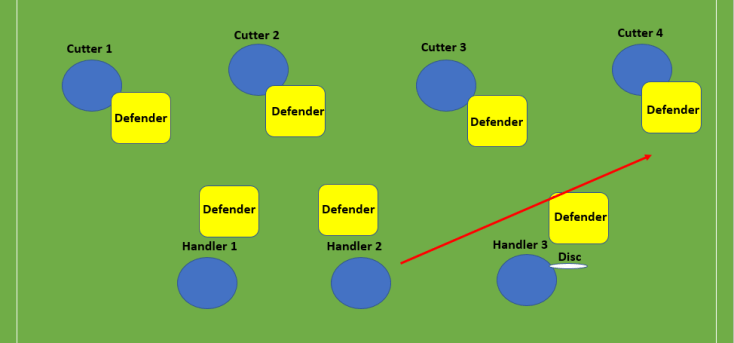 This offensive overload is exactly what Keita does for Liverpool. By making a forward run and taking control of the ball, Keita forces defenders to make a choice. They either stay with the forward they’re marking and let Keita drive forward with time to pick out a key pass, or they move out to him and leave their mark open for Keita to pass to. This is exactly what can happen in Ultimate if the defenders marking a cutter step forward to try and challenge for the disc with a Handlers forward cut.
With a Ho Stack, the general aim is to gain yards up the field by passing the disc from handler up to cutter, returning it to a handler further up the field and restarting the process again and again and again till you reach the end zone to score. Liverpool’s attacking tactics are obviously slightly different but if you’re asked to play this formation for the first time, think of how Salah and Firmino interchange position moving like an engine piston. They never cut into the same space, if one goes deep the other comes short, if one goes wide the other cuts inside and they rely on the support of their midfield’s forward and supporting runs. If you play Ho Stack, think of Klopp’s Reds: Keita, Fabinho and Wijnaldum are the handlers; Mane, Firmino and Salah are the cutters.
Zone Offence = Guardiola’s Tiki Taka Offence
“Move the opponent… invite the opponent to press, you have the ball on one side you finish on the other.”
“We do not pass to move the ball, we pass to move the opposition.” Pep Guardiola
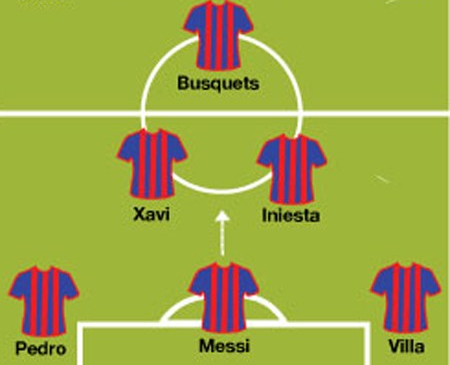
Again, let’s try to keep it simple. In Guardiola’s arguably greatest Barcelona side, Busquets, Xavi and Iniesta played as a three behind Pedro, Messiand David Villa in attack. Their game was focused on: a domination of possession using detailed pitch maps designating specific areas for players to target in the half-spaces of opposition formations; positional overloads of certain areas through Messi dropping in as a False 9 or Busquets dropping into defence as the pivot to create rhombus’ and triangles to ensure a numerical superiority around the ball where his players could simply outplay the opposition with their positional and technical brilliance. ‘Tiki Taka’ is what Guardiola made famous but this infers that his teams pass for the sake of it which is a falsehood and a disservice to his tactics. They passed to drag the opposition out of formation, to quickly move up the pitch and to open up gaps which they can then exploit with a killer pass into a forward. This is where the similarities with zone offence come in.
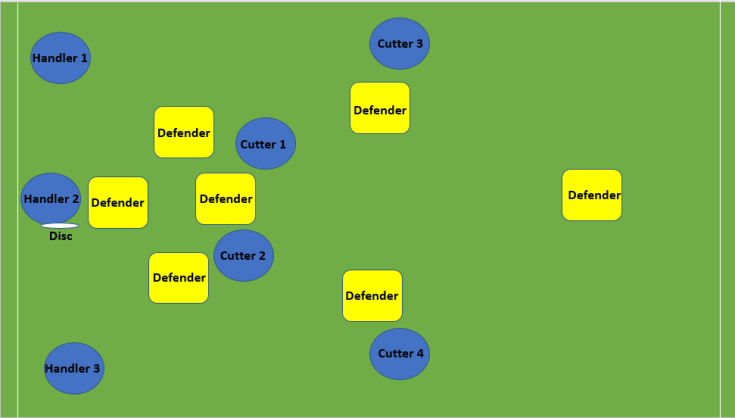
In this formation, the three handlers (I.e. Iniesta 1, Busquets 2 and Xavi 3) are responsible for retaining possession of the disc. By swinging it from left to right they force the opposition’s Mark (defender closest to the disc) and the cup of three defenders behind them to run backwards and forwards, tiring them out and inevitably opening up space for a forward throw to one of the cutters.
Meanwhile, (like Messi for Barca) Cutters 1 and 2 operate in the spaces between the defenders. When one makes a cut short the other will go deep and the moment the handlers get a pass to them past the Mark and Cup, they can turn and look for a killer pass just as Messi does when he receives a pass in the space between midfield and defence.
Cutters 4 and 5 behave like Pedro and Villa. Waiting patiently for an open space when the handler on their wing receives the disc, they can either cut short or deep to receive the disc and gain many yards. If they do receive it behind the cup, they will have a numerical advantage over the opposition defence to work with as Cutters 1, 2 and 4 will be further forward against only 3 defenders i.e. 4 v 3. This will create opportunities to simply pass round the defence to score in the end-zone, just as Barcelona create overloads to score goals.
In essence, for Barcelona and zone offence there are four main points used to break down the opposition and score.
- Retain possession.
- Move the disc/ball quickly and always be moving to stretch the opposition and create spaces.
- Outnumber the defence in key areas through players dropping into half-spaces.
- Once you are past the cup/midfield, there should always be a man free to play the killer final pass to.
So, if you are playing zone offence for the first time as a handler, think Xavi, Busquets and Iniesta. If you are a cutter, think Messi, Pedro and Villa. Above all, if you are new to zone offence and come from a footballing background, remember Guardiola’s tactics and this will give you a general idea of what is expected of you using this Ultimate tactic.
Vertical Stack = Corner Taking on Repeat
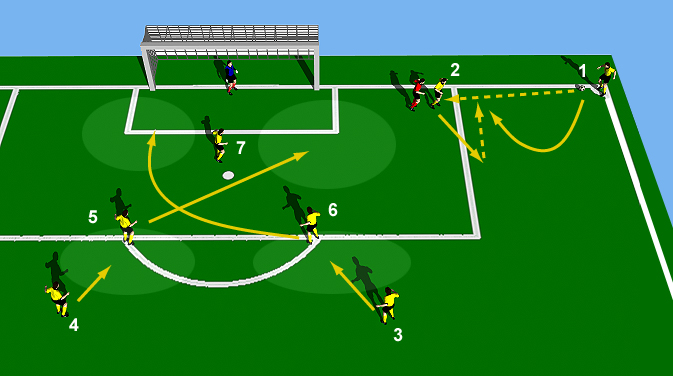
The final offensive tactic is the most basic and commonly used to teach beginners how to play in a match. Vertical Stack puts focus on creating one on one battles for each player and their mark when getting into space and receiving the disc. The main aim behind the Vert Stack is for cutters to move into space to receive the disc, reform the stack further up the pitch and repeat this until you are near the end zone to score. Players in the stack must have a plan for who is going to cut where and when to ensure that there is never more than one player cutting into an open space. Organising who is going to cut deep or short in Ultimate is not dissimilar to the way that many football teams organise their attacking corners in that the players will have pre-organised where and when they are all going to make their runs (front post/back post/edge of the box/short etc.) before the corner is taken.
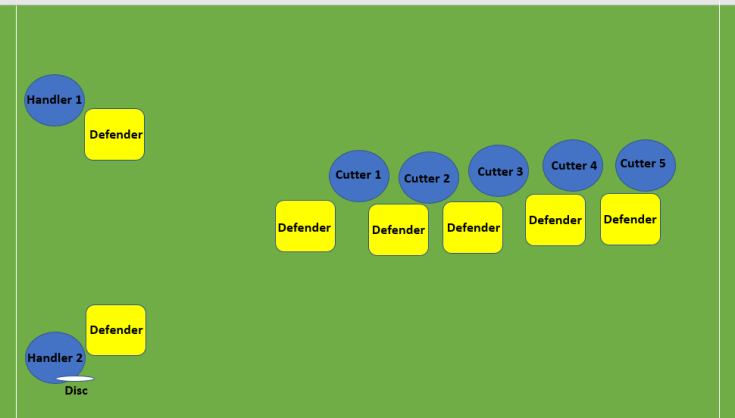
In the graphic above you can see that the cutters are all lined up away from the handlers so there is space on the wing for them to run into and receive a pass. It is important as a cutter that you surprise your marker and beat them for pace with your short/deep cut so that you are a viable option for the handler with the disc, just as football players in the box for a corner must beat their marker to attack the ball first. Defenders will mark disc-side of you to try and give themselves an advantage but if you are sharp you can beat them into space to the disc.
In the next graphic the basic movements are outlined. When Cutter 5 makes their short cut, (the red arrow) if they receive the disc they become the handler. Handler 2 will then move into the stack and the team will return to the beginning set-up – just further up the pitch. If Handler 2 doesn’t throw to Cutter 5, it is important for them to move out of the space back into the stack (second red arrow) so other cutters can make a similar cut. As they do this the rest of the stack will move up (small red arrows) so the stack is re-set in the same position.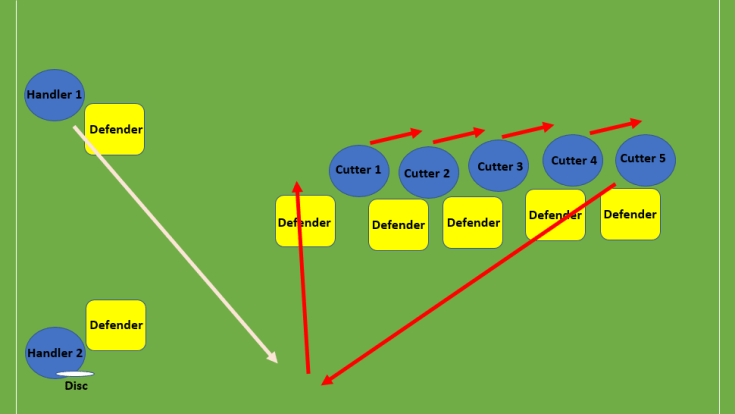 Another option with the Vert Stack if all the cutters have been marked out of the game is to use the other handler. Designated by the white arrow in the graphic above, Handler 1 has the option to cut up the line into that space to receive the disc and immediately look for a cutter to make a deep cut up the line as they will be ahead of their defender. This is almost like a short corner routine when you feel it would be better to retain possession and ask player to come short, make a simple pass and go from there. The cutting options described here should underline that Vert Stack is almost like repetitively lining up for corners in football further and further up the pitch. When you are playing Vert Stack, organisation, timing and commitment to your cuts are of utmost importance, exactly the same as trying to score a corner in a game of football.
This is a more complicated piece than some of the others on ‘The Ultimate Sport’ but the hope is that beginners with an understanding of football can look at this and gain a basic understanding of what is expected if they are asked to play any of these three specific offensive tactics. Granted, these are the absolute basics of the tactics but hopefully the football comparisons are useful for beginners and entertaining for veterans. As always, give this piece a like if you enjoyed it, share it with a friend who needs help understanding these offensive tactical basics and give the Facebook page a like! Cheers!
 THE ULTIMATE SPORT
Leave a comment